Table of Contents▼
- Available Subjects
- About CE at MMMUT Gorakhpur
- Key Highlights
- Programs Offered by the Civil Engineering Department
- Minor Degree Programs in Civil Engineering (For Other Branches)
- Total Seats for B.Tech in Civil Engineering at MMMUT
- Civil Engineering Laboratories
- Past Recruiters for Civil Engineering at MMMUT
- Scope, Careers and What Actually Happens
Available Subjects
Civil Engineering subjects at Madan Mohan Malaviya University of Technology, Gorakhpur are organized semester-wise below. Click any subject to open its PYQ PDF directly.
Semester 1
Semester 2
About CE at MMMUT Gorakhpur
Established in 1962, the Civil Engineering Department is one of the oldest departments at MMMUT Gorakhpur. The department offers B.Tech., M.Tech., and Ph.D. programmes in various areas of civil engineering. Over the years, it has developed academic links with industry, government organizations, and its alumni network.
The department is supported by experienced faculty members and provides students access to software such as ANSYS, MIDAS, STAAD Pro, MATLAB, SAP 2000, OPTUM G2, and CASTER for academic and research-related work.
Key Highlights
- Core branch focused on infrastructure and design
- Concept and numerical-based subjects
- Requires patience and consistent effort
- Important for government and public sector roles
- Long-term benefits with steady preparation
Programs Offered by the Civil Engineering Department
Undergraduate Programme • B.Tech. in Civil Engineering Postgraduate Programmes • M.Tech. in Seismic Design and Earthquake Engineering • M.Tech. in Structural Engineering • M.Tech. in Environmental Engineering Doctoral Programme • Ph.D. in Civil Engineering
Minor Degree Programs in Civil Engineering (For Other Branches)
Let’s be completely honest—opting for an extra minor degree is a real academic load. Because of this extra pressure, many students (especially from high-demand branches like CSE or IT who already have a lot of career scope) usually avoid taking it. Generally, students from other core branches or those who have a genuine, serious interest in infrastructure and construction are the ones who go for a Civil Engineering minor. ► The Real Advantage of the Extra Load Yes, it is extra work, but the real value shows on graduation day. While most of the crowd walks out with just one degree, you will have two. Studying two different fields literally opens two separate doors for your career. Having that extra, legal certification on your resume automatically puts you ahead in the market race. You can even grab part-time jobs or freelance drafting work based on this minor degree. Over time, if you gain enough practical experience, this "minor" knowledge can easily turn into a full-fledged career. However, remember that the degree only helps if you actually learn the real skills that the industry uses. ► Available Minor Options in Civil Engineering If you decide to take this path, the CE department offers six major specializations. You can choose only one of the following for your entire B.Tech journey. (Note: This specific list is for the 2024-2028 batch. The options can change for future batches, so always verify with the official department notice when you are in your 4th semester). • Minor 1: Structural Engineering • Minor 2: Geotechnical Engineering • Minor 3: Environmental Engineering • Minor 4: Transportation Engineering • Minor 5: Water Resources Engineering • Minor 6: Geospatial Technology ► Subject Highlights (What you will actually study) To earn the minor degree, you need to clear one extra subject (carrying 4 credits) per semester from Semester 4 up to Semester 8, collecting a total of 20 extra credits. Here is a quick look at what you might study depending on your choice: • If you choose Structural Engineering: You will study Matrix Method of Analysis, Structural Dynamics, Repair and Retrofitting of Structures, Advance Concrete Technology, and finally, Seismic Design of Structures. • If you choose Geospatial Technology: Your subjects will include Global Positioning System, Principle of Remote Sensing, Web Technology for GIS & Mapping, Spatial Information Technology, and Spatial Data Quality Assessment. ► The Minimum Student Requirement Just like every other department, Civil Engineering follows a basic rule before starting these extra classes. A specific minor subject will only be taught if a minimum number of students (usually 15) select it. If there aren't enough interested students, the college simply drops that option for the batch. In that scenario, you will have to pick another available minor area that has enough students to run the class.
Total Seats for B.Tech in Civil Engineering at MMMUT
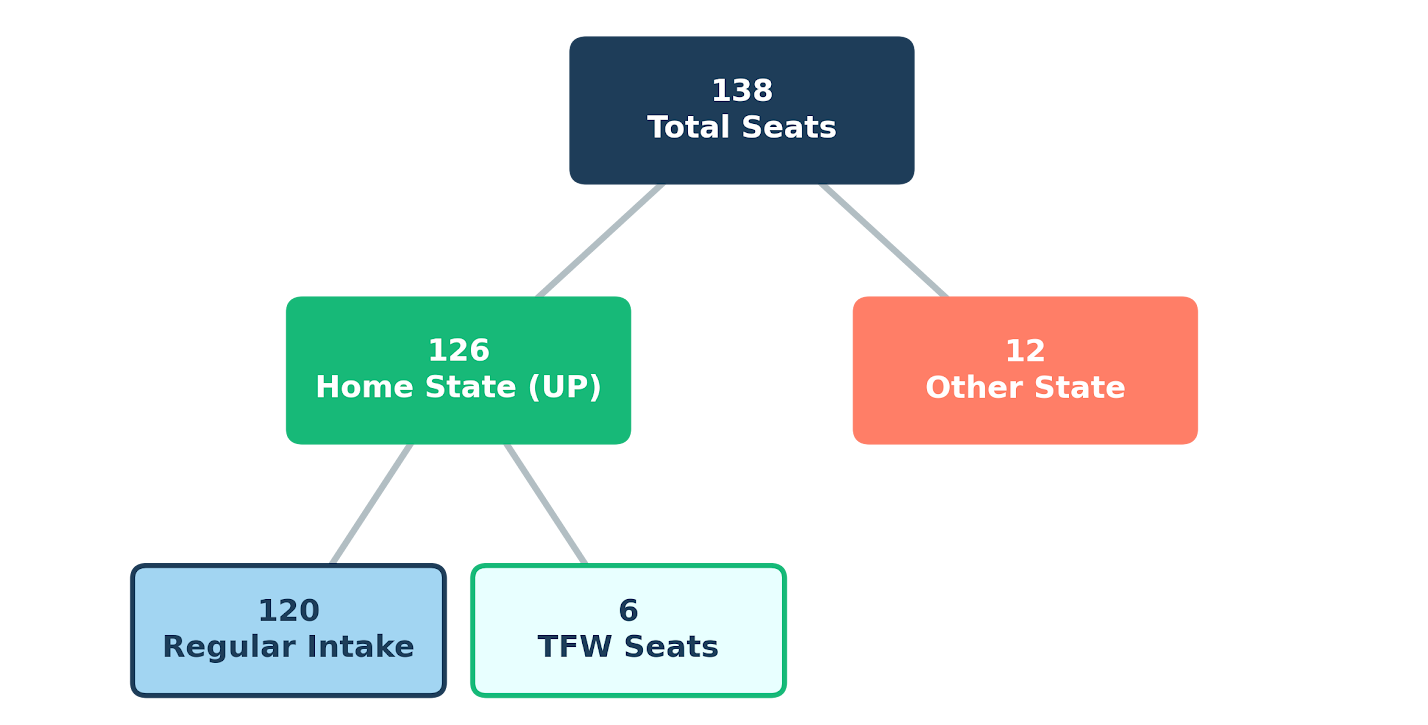
The Civil Engineering branch offers a total of 138 seats in the first year. The division is exactly 120 regular seats, 6 TFW seats for home state students, and 12 seats for other state candidates. Before the spot round, internal sliding takes place where existing students shift to higher branches if some regular students drop out. Due to this shifting, a good number of seats usually remain empty in Civil for the spot counseling.
Civil Engineering Laboratories
The Civil Engineering Department has a number of laboratories that support different areas of the curriculum. These facilities are used for laboratory classes, project work, and subject-specific experiments conducted during the course. The department maintains laboratories related to geotechnical engineering, environmental engineering, transportation engineering, structural engineering, hydraulics, surveying, and engineering geology. Major laboratories in the department include: • Geotechnical Engineering Lab • Environmental Engineering Lab • Air Quality Lab • Highway Engineering Lab • Hydraulics & Water Resources Engineering Lab • Survey Lab • Concrete Lab • Structures Lab • Mechanics of Structure Lab • Computational Lab • Engineering Geology Lab
Past Recruiters for Civil Engineering at MMMUT
For Civil Engineering students at MMMUT, the placement scene is mostly about infrastructure, construction, and heavy manufacturing. If you look at the past placement records, top industry names like Larsen & Toubro, JSW, and Aditya Birla Group regularly recruit from this branch.
| Company Type | Top Recruiters (MMMUT CE) |
|---|---|
| Core Construction & Infra | |
| IT Services & Tech |
These companies usually offer roles related to site management, structural engineering, and cement or concrete manufacturing. Note: Keep in mind that the number of hires and the companies visiting the campus can change every year depending on the job market. To get the exact and latest placement stats, always make sure to check the official MMMUT website.
Scope, Careers and What Actually Happens
Civil Engineering offers opportunities in construction, government jobs, infrastructure development and public sector roles. However, many students also explore alternative paths like competitive exams or non-core jobs depending on their interest. Core opportunities exist but usually require patience, preparation and long-term planning. Students who stay consistent tend to benefit the most from this branch.