Explore top B.Tech colleges—check latest cutoffs, official fee structures, seat matrix, and download semester-wise PYQs easily.
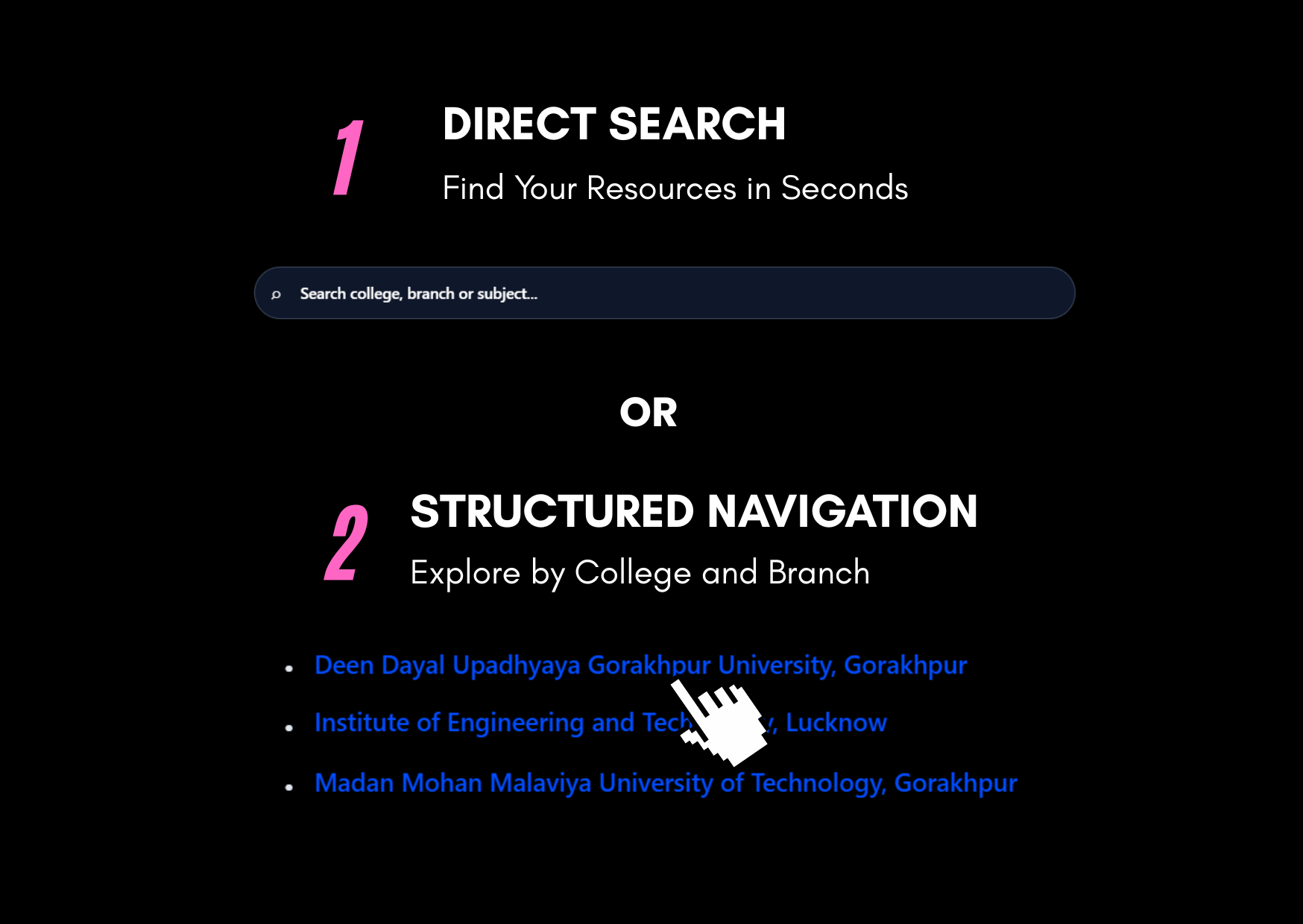
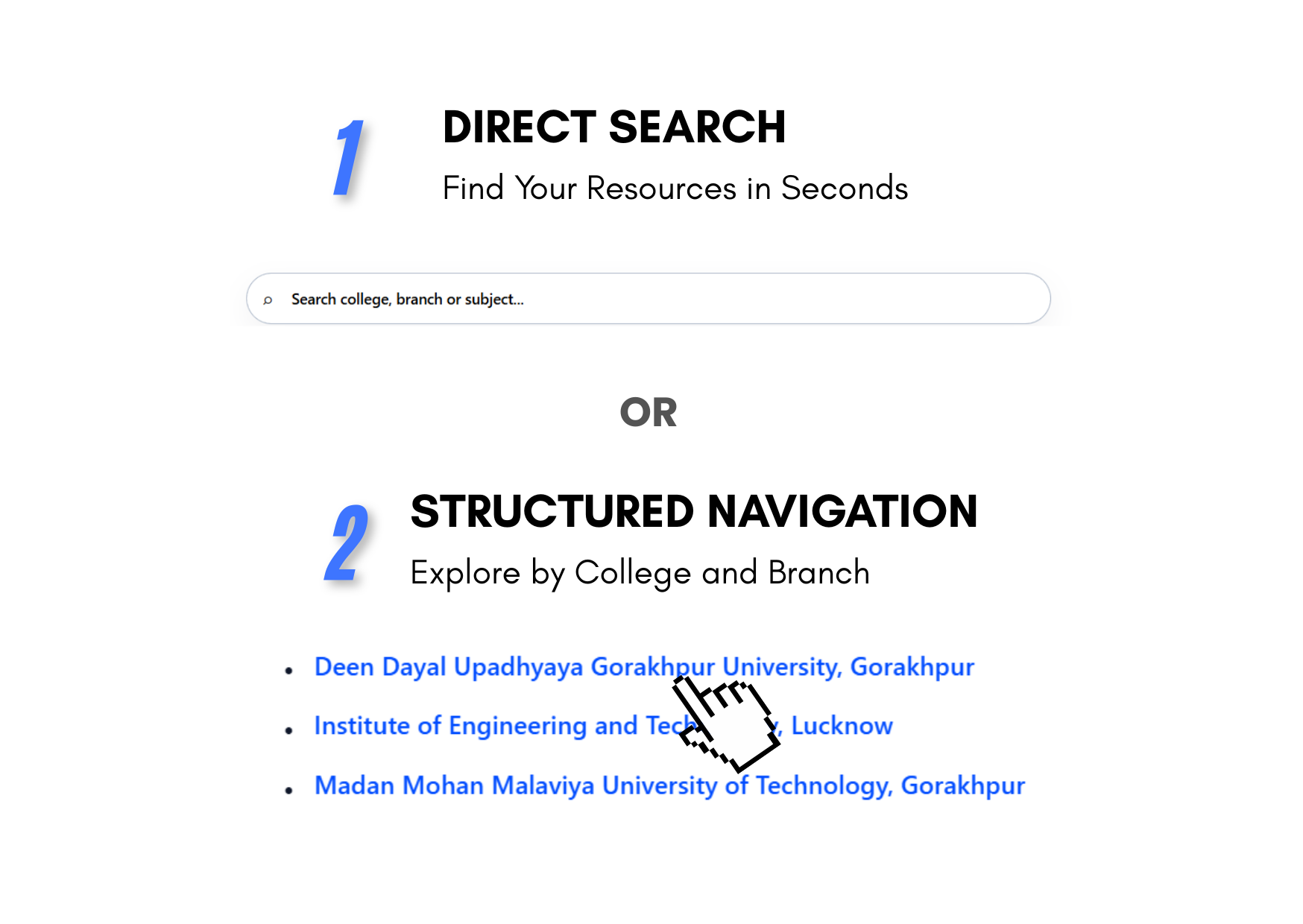
Search directly for a college, branch, or subject to open PYQs instantly. Alternatively, select a college from the list below to check its placements, cutoffs, and fees, then choose your branch to see all semester-wise subjects.
⌕
Try college names, branches like EE/CSE, or subject names.
Available Colleges
Pick your college from the list below to open its dedicated page. On this page, you can check everything about the college—including its latest placement records, highest and average packages, official seat matrix, and admission process.
We've kept the navigation super simple so you don't get lost: select your college first, then your branch, and you'll find all your subjects organized right there.
Most students waste crucial exam time begging in senior groups or WhatsApp chats for a single PYQ PDF, only to end up with outdated links or wrong files. Save yourself from that struggle—just start from your college page, click your branch, and get the exact PYQs and details you need instantly.
Last Night Study Tips That Actually Help Before Exams
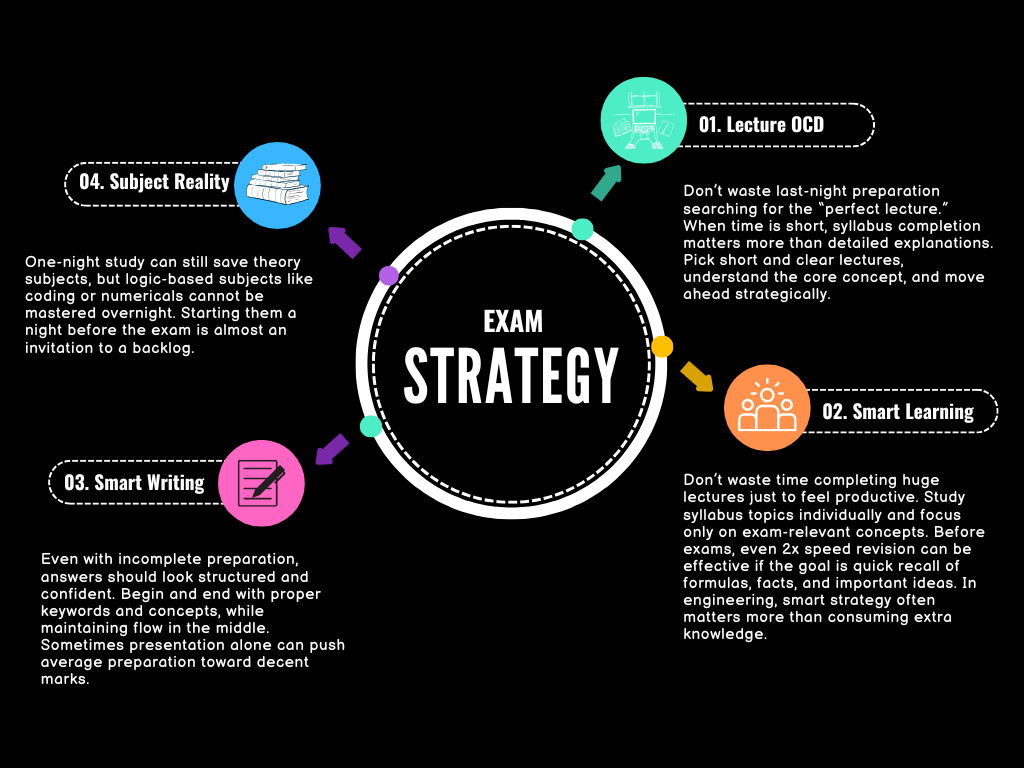
The biggest mistake students make one night before the exam is trying to start from unit one. Let's be real. You have a 500-page book, notes you barely understand, and only 10 hours left. At this point, trying to finish the whole syllabus will only create massive panic. Your goal right now is not to top the exam, but to secure enough marks to pass comfortably or get a decent grade without failing.
Instead of opening chapters you have never seen before, look at the previous year papers. For example, in subjects like Basic Electrical or Engineering Mathematics, there are always some fixed derivations or theorem proofs that come every single year. Maybe it is the Superposition theorem or a specific matrix problem. If you just lock down these 3 or 4 guaranteed questions perfectly, you easily secure 20 to 30 marks straight away. This is much better than reading five different units halfway and then forgetting the exact steps when you sit in the exam hall.
Another big trap is the fake feeling of studying. Watching a 10-hour video playlist on 2x speed at 2 AM makes you feel like you are understanding everything. But the moment you get the question paper, your mind goes completely blank because you never practiced it on paper. Reading or watching is passive. Before the exam, always write down the main formulas and block diagrams with your own hands at least once.
How Students Should Actually Use PYQs
A lot of students think previous year papers are just question banks to memorize. They learn the exact answer to a specific question line by line. But university professors are smart. They will give the exact same circuit or logic but change the resistance values from 5 ohms to 10 ohms, or they will ask the same theory question by twisting the words. If you only memorized the answer, you will freeze and think the question is out of syllabus.
The correct way to use PYQs is to find the hidden syllabus. Suppose you notice that a question about 'PN Junction Diode' has been asked three times in the last four years. Don't just read the answer to that one specific question. Open your notes and read the entire 'PN Junction' topic. Understand its diagram, its working, and its graph. This way, whether the professor asks for its working, its characteristics, or its application, you are ready to write a full 10-mark answer.
PYQs tell you what the professor likes to ask, but you still need to study that topic properly. They show you the direction, but if you do not clear the basic concept of that repeated topic, you won't be able to write a proper long answer.
How to Present Answers to Score Maximum Marks
Let's understand the psychology of the person checking your copy. A professor has to check hundreds of answer sheets in a few days. If you write a 3-page long story in a single paragraph without any breaks, the checker will get frustrated. They do not have the time or energy to search for the right points in your long paragraphs. Because of this, they might just give you average marks, even if your answer is technically correct.
1. Draw First, Write Later
You have to force the checker to give you marks. How? Draw a diagram. Even if a question is purely theoretical, try to make a flowchart. For example, if they ask about the components of a computer network, don't just write a list. Draw a quick block diagram showing how the components connect, and then explain them in bullet points. The moment the checker sees a neat diagram, their brain assumes you know the subject well.
2. Make the Checker's Job Easy
Similarly, for numericals, always draw a box around your final answer. If the final answer in the box is correct, many checkers will just tick it and give you full marks without reading every single calculation step in the middle. Put your main formulas in boxes and underline key words. Make their checking process easy, and they will reward you with good grades.
Quick PYQ Access
Let's be real—when you visit a new study website, the first question in your mind is usually, "Does this site actually work, or will it just redirect me to fake ads?" The list below is a completely random mix of PYQs from different colleges, branches, and semesters. We put this here simply as a quick test drive. You can click on any random subject below just to see how fast and directly the real question papers open.
If you get lucky and spot the exact subject you need right now, you can open it directly from here and save some time. But since these links are randomly generated on every refresh, do not rely on this section to find your complete syllabus. For your proper semester-wise papers, always use the main college selection menu above so you don't miss out on any important subjects.
Revision does not mean reading your entire notebook again. When you have only a few hours left, you need to filter your study material. First, strictly finish the topics that dominate the PYQs. Then, move to standard derivations. Keep the final hour just for looking at formula sheets. If you try to learn something completely new at the last minute, you will mix it up with what you already know.
The most common mistake happens at 3 AM. You realize one unit is left, so you decide not to sleep at all. You drink coffee and push through. But when you finally get the paper at 9 AM, you read a question you know, but you just cannot remember the exact formula. Your brain is so tired that you make silly plus-minus mistakes in simple calculations. This happens to almost every engineering student.
Writing a 3-hour technical paper takes a lot of brain energy. Sleeping for just 4 hours will actually save the memory of whatever you studied the whole night. It is always better to go into the exam hall with 80% of the syllabus covered and a fresh mind, rather than 100% of the syllabus covered with a dead, sleepy brain.
Most Viewed Colleges
Based on lifetime PYQ views across all subjects
RankCollegeLifetime Views
1
Madan Mohan Malaviya University of Technology, GorakhpurMMMUT Gorakhpur
824
2
Institute of Engineering and Technology, LucknowIET Lucknow
210
3
Deen Dayal Upadhyaya Gorakhpur University, GorakhpurDDUGU Gorakhpur
149
Most Viewed Branches
Based on lifetime PYQ views across all colleges
RankBranchLifetime Views
1
Electrical EngineeringEE
574
2
Civil EngineeringCE
144
3
Electronics and Communication EngineeringECE
126
4
Computer Science and EngineeringCSE
120
5
Chemical EngineeringCHE
103
6
Mechanical EngineeringME
69
7
Information TechnologyIT
47
Frequently Asked Questions
Are these college PYQs free to access?
Yes. Students can freely access the available previous year question papers on PYQora for learning and exam preparation.
How are college PYQs organized on this page?
College PYQs are organized through a simpler article-style flow where students can search by college, then move toward branch and subject in a more structured way.
Why are previous year questions important for university exams?
Previous year questions help students understand exam patterns, important topics and commonly repeated concepts in university examinations. They are widely used for effective revision and exam strategy.
Can PYQs help improve exam performance?
Yes. Solving PYQs regularly helps students identify important topics, practice real exam questions and improve their confidence before university exams.